My 360 cannabis videos are not video. There is no gimbal and no camera orbiting the bud. Each spin is a few hundred still photos of a cola on a turntable, built into a clip in After Effects. This is the whole process, settings included.
Some gear links below are Amazon affiliate links. As an Amazon Associate I earn from qualifying purchases. It costs you nothing extra.
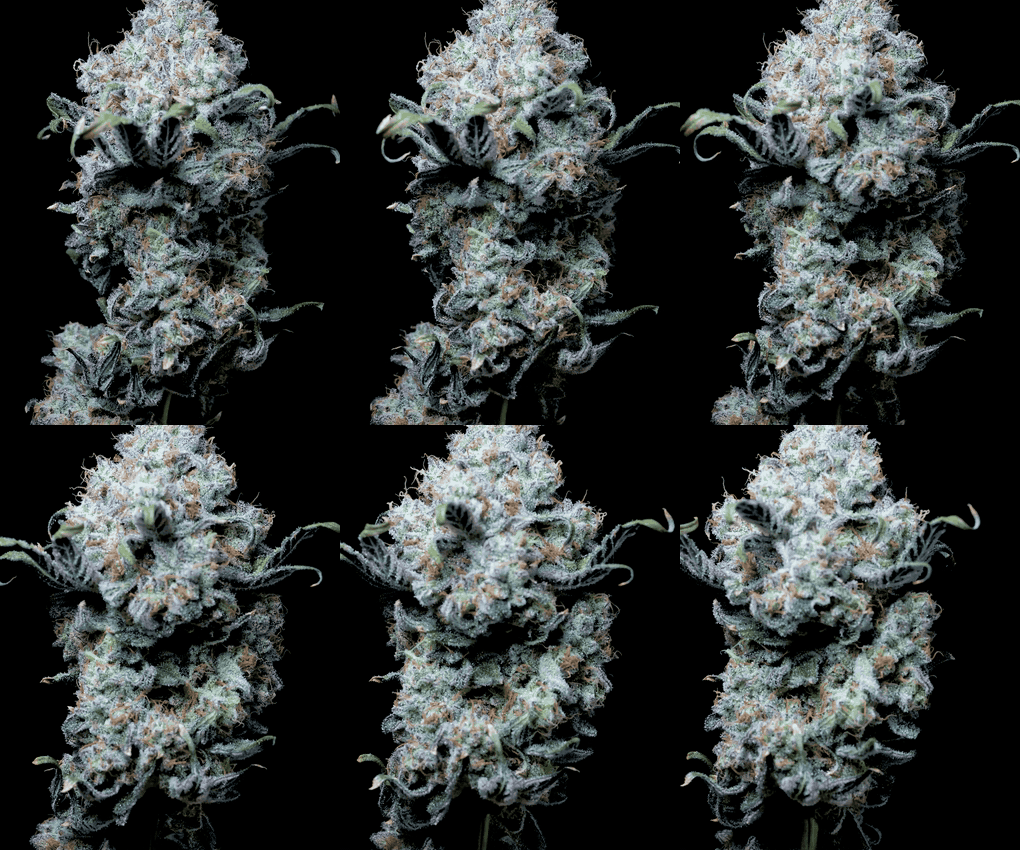
Why I shoot stills instead of video
My camera is a Sony a7 III. In video mode it tops out at 4K. In photo mode every frame is 6000 pixels wide, which is where the 6K comes from. A 6000 x 4000 still has almost three times the pixels of a 4K video frame.
That extra resolution does real work. I can crop a vertical 4K Reel out of the frame without upscaling. Warp Stabilizer crops in when it smooths a shot, and at 6K I never notice the loss. And every single frame of the spin is a full-resolution product photo the client can use on a menu or a jar label.
The 360 product photography setup
| Piece | What I use |
|---|---|
| Camera | Sony a7 III, 24MP full frame, built-in interval shooting |
| Main lens | Sigma 70mm F2.8 DG Macro Art |
| Close lens | Laowa 2x manual macro for trichome-level spins |
| Turntable | Motorized photography turntable that moves in small steps |
| Support | A heavy tripod. Nothing can move for 45 minutes. |
| Power | Dummy battery so the camera never dies mid-spin |
| Light | Continuous LED light. No flash, no window light. |
You do not need the macro lenses to start. One of my 720-frame spins was shot on the Sony 28-70mm kit lens at 60mm, and it held up. The macro glass matters when you want the frame filled with trichome heads instead of the whole cola.
The turntable and the 4 second rule
The cola stands upright in the center of the turntable. The turntable advances a small step every 4 seconds. The camera's interval timer fires every 4 seconds. The bud moves, settles, gets photographed, and moves again.
The cheap display turntables that spin a full turn in 30 seconds are too fast for this. You want one with a slow or stepped mode and a remote.
Frame count decides how smooth the final video plays. My spins run between 387 and 720 photos. At 720, each frame is half a degree of rotation, and the shoot takes 48 minutes. Played back at 30 frames per second that is a 24 second clip. A 575-frame spin takes about 38 minutes and gives you 19 seconds.
Centering is the part nobody mentions. If the stem is off the turntable's axis, the cola orbits instead of spinning in place. Spend five minutes nudging it and checking through the viewfinder at a few positions. What you cannot fix by hand, After Effects cleans up later.
Camera settings: lock everything in manual
A spin is hundreds of photos that have to look like one continuous shot. Anything the camera decides for itself will change between frames, and you will see it as flicker.
- Manual exposure. Shutter between 1/10 and 1/40, ISO between 1250 and 3200 depending on the light. Slow shutters are fine because the bud is sitting still when the frame fires.
- Aperture around f/10. My early spins were at f/22 to get the whole cola sharp. Stopped down that far, diffraction softens everything. Around f/10 the trichomes stay crisp and there is still enough depth.
- Manual white balance. Set a Kelvin value or a custom reading off a gray card. Auto white balance shifts a little on every frame as the bud turns, and the color pulses through the whole video.
- Manual focus. Focus once with the magnified view and leave it. Autofocus hunts between frames and the spin breathes in and out.
- JPEG, highest quality. A full spin in RAW is a mountain of data, and After Effects reads a JPEG sequence directly.
- Stabilization off. The camera is on a tripod.
On the a7 III, interval shooting is in the camera menu: set the interval to 4 seconds and the shot count to whatever your spin needs. Turn the room lights off, close the blinds, start the turntable, start the timer, and leave it alone.
The best macro lens for cannabis photography
I shoot most spins on a Sigma 70mm Macro Art and switch to a manual Laowa when I want to go closer. If I were buying a macro lens today, these are the three I would look at, from most expensive to least.
- Sony FE 90mm f/2.8 Macro G OSS. The standard macro for Sony cameras since 2015. True 1:1 magnification, autofocus for regular product shots, and a focus clutch that snaps into manual for spins. If you only buy one macro lens, buy this one.
- Sigma 105mm f/2.8 DG DN Macro Art. The same 1:1 magnification and very sharp, for less money. The extra length also puts more room between the lens and a sticky cola.
- Laowa 100mm f/2.8 2X Ultra Macro APO. The cheapest of the three, and the only one that reaches 2x magnification, which is where trichome heads fill the frame. It is fully manual with no electronics. For spins that costs you nothing, because you set focus and aperture by hand anyway.
If you want to see what that level of detail shows about a flower, I wrote about it in what the macro lens knows about your flower.
Import the JPEG sequence into After Effects
- File, Import, File. Click the first JPEG of the spin.
- Check the JPEG Sequence box in the import dialog, then import. After Effects treats the whole folder as one clip.
- Right-click the clip, Interpret Footage, Main. Set the frame rate to 30. Use 60 if you shot enough frames and want it faster and smoother.
- Drag the clip onto the New Composition icon so the comp matches the footage at full 6K size.
That last step matters. Warp Stabilizer refuses to run if the layer and the comp are different sizes, which is the error most people hit first.
Warp Stabilizer is the secret sauce
Straight off the card, a turntable spin looks a little mechanical. The steps are slightly uneven and the cola wobbles on its axis. Warp Stabilizer is what turns it into that floating look.
Apply Effect, Distort, Warp Stabilizer to the 6K layer and let it analyze. It is slow at this resolution, so go do something else. Set the result to Smooth Motion. If the default Subspace Warp method makes the bud look like jelly, switch the method to Position, Scale, Rotation. Fine plant detail confuses the warping, and the simpler method holds its shape.
Then I turn on frame blending in Pixel Motion mode, which is After Effects' optical flow. It builds in-between frames, so the rotation reads as continuous motion instead of steps. A straight ffmpeg stitch of the same photos never looks this smooth, and this is the reason.
Last, nest the stabilized 6K comp inside a delivery comp: 2160 x 3840 for Reels, or 3840 x 2160 for a website or a product page. Shoot with the camera turned to portrait if vertical is the main deliverable. Scale and reframe in the delivery comp, and export.
Mistakes that ruin a spin
- Auto anything. White balance, ISO, and focus all have to be locked.
- Window light. Over 45 minutes the sun moves and your exposure drifts with it.
- Bumping the table. One nudge at frame 400 and the spin has a visible jump.
- A battery that dies at 80 percent of the way around.
- Too few frames. My shortest spin is 387 photos. Go much lower and the rotation stutters, and optical flow starts smearing to cover the gaps.
Why this matters for selling flower
A hero shot shows the one angle the grower picked. A 360 shows all of them, and buyers trust it for that reason. Spins are part of the wholesale funnel I built for a New Mexico cultivator, and there is more of this on the work page.
That is the full recipe. If you would rather have it shot for you, Canneye is based in Albuquerque and travels. The form below reaches me directly.